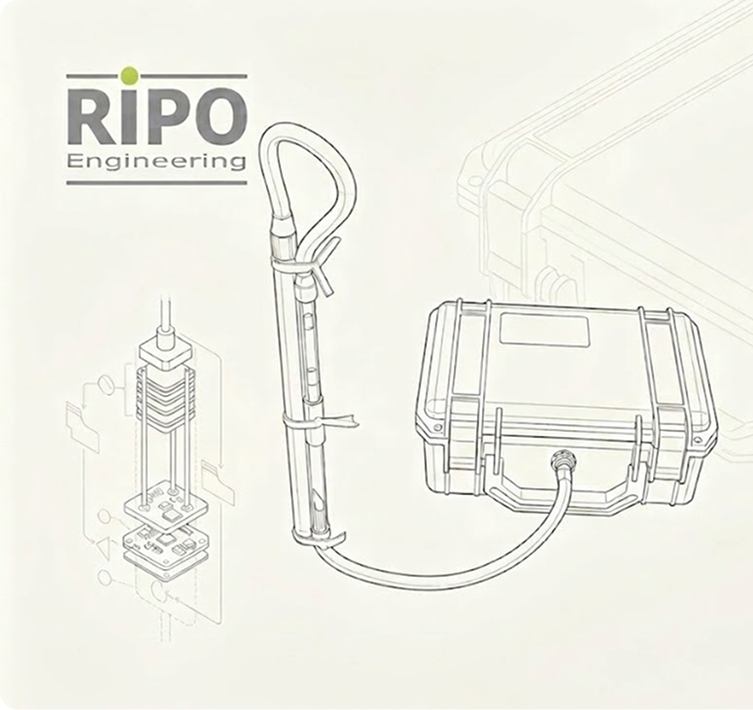
This page collects what you need to run a RIPO sampling pump in the field: a quick reference for a standard run, guidance on calibration and servicing, and where to find the downloadable manuals and data sheets.
Before you start
- Charge the battery fully — about three hours over USB-C.
- Check the calibration certificate date. Re-calibrate annually, or sooner if the run log shows flow drifting from setpoint.
- Have the right sorbent tubes for your target compounds and the laboratory’s method.
- Fit a fresh inline filter and check the tubing for kinks or splits.
Running a sample
- Install the probe. Drive or place the probe to the target depth and let the borehole equilibrate. Connect the probe line to the pump inlet.
- Load the sorbent tube. Fit the tube into the inline holder with the arrow pointing toward the pump, and record the tube ID.
- Set flow and volume. Dial in the flow rate and the target volume, purge the line, then start. The pump holds the setpoint and stops itself at volume.
- Log and despatch. Export the run log as CSV, cap the tube, and send it to the laboratory with the chain-of-custody form.
Calibration and servicing
Every pump ships with a flow calibration certificate traceable to a national standard, and we recommend annual re-calibration. Our return-to-base service turns most units around within five working days, and a loaner pump can be arranged to cover the gap. The pump head is field-serviceable — replacement diaphragms, valves and filters are stocked.
Downloads
The full user manual, quick-start card and current data sheet are available to account holders in the customer portal, along with firmware updates and past manual revisions. Contact us if you need a copy before your account is set up.
Support
Questions about a method, a sorbent, or a reading that does not look right? Email [email protected] or call +45 50 12 30 05. We would rather hear from you mid-project than after the lab results come back.