Steady low flow
Closed-loop control holds the setpoint within ±5 % from 50 to 500 mL/min, compensating for tube back-pressure as the sorbent loads.

Environmental sampling equipment
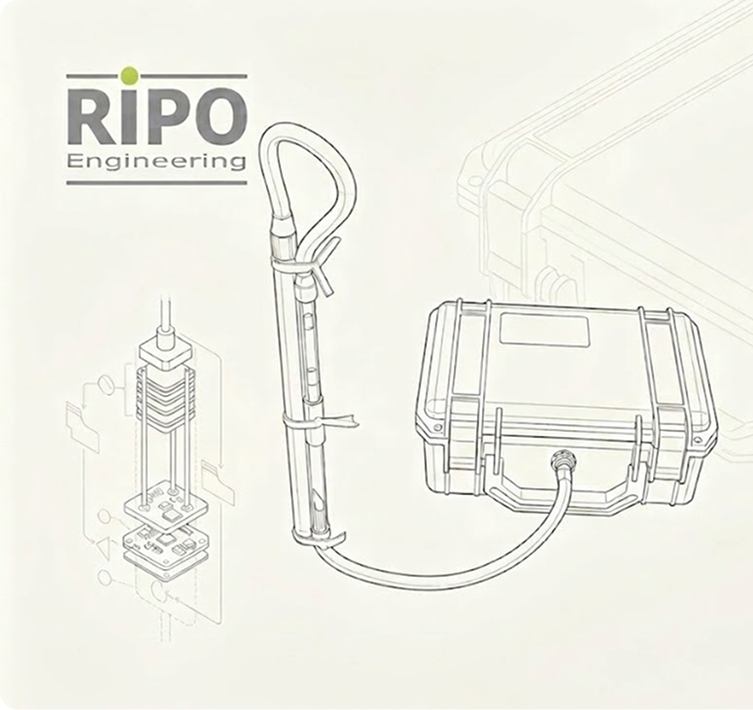
Ripo builds the carbon-tube pumps that environmental consultants and laboratories rely on to draw soil gas through sorbent tubes — at a controlled low flow, with the sample volume recorded to the millilitre.
What it is
Soil gas sampling means pulling a measured volume of pore-space air from the ground through a tube packed with activated carbon or another sorbent, then sending that tube to a laboratory for analysis of volatile compounds — BTEX, chlorinated solvents, TPH and similar. The result is only as good as the pump: the flow has to stay steady and low, and the total volume has to be known.
Ripo’s pumps are engineered around exactly that job. Each unit holds its set flow across the whole run, doses to a target volume and stops itself, and logs the run so the field record matches the chain of custody. They are compact, field-serviceable, and shipped with a traceable calibration certificate.
Method
Four steps in the field. The pump handles the parts that have to be exact.
Drive or place the soil gas probe to the target depth and let the borehole equilibrate. Connect the probe line to the pump inlet.
Fit a 6 mm carbon, Tenax or silica-gel tube into the inline holder, arrow pointing toward the pump. Record the tube ID.
Dial in the flow rate (e.g. 200 mL/min) and the target volume (e.g. 2 L). Purge, then start. The pump stops at volume.
Export the run log, cap the tube, and send it to the laboratory with the chain-of-custody form. Recharge over USB-C.
Why the pump matters
Everything here exists to make the number the lab reports trustworthy.
Closed-loop control holds the setpoint within ±5 % from 50 to 500 mL/min, compensating for tube back-pressure as the sorbent loads.
Set the litres you need. The pump integrates flow over time and shuts off automatically — no over-pull, no manual stopwatch.
Start/stop time, average flow, delivered volume, ambient temperature and battery state, exportable as CSV for the project file.
14 hours of continuous sampling at 250 mL/min on one charge. USB-C in, hot-swappable battery pack available.
Works with 6 mm OD sorbent tubes from the common suppliers — activated carbon, charcoal, Tenax TA, silica gel, multi-bed.
Every unit ships with a flow calibration certificate traceable to a national standard. Annual re-calibration service available.
Data sheet
Representative figures for the current model. Final published values are confirmed on the data sheet.
| Flow range | 50 – 500 mL/min, adjustable in 5 mL/min steps |
|---|---|
| Flow accuracy | ±5 % of setpoint, actively regulated against back-pressure |
| Volume metering | Integrated; auto-stop at target volume, 0.1 – 20 L |
| Back-pressure capability | Up to 40 in. H₂O (≈ 100 mbar) at rated flow |
| Battery | Li-ion, 14 h at 250 mL/min; USB-C PD charging, ~3 h full |
| Data | Run log with CSV export; on-device screen; USB-C data |
| Tube compatibility | 6 mm OD sorbent tubes — carbon, charcoal, Tenax TA, silica gel, multi-bed |
| Inlet / connections | Luer-lock and 6 mm push-fit; PTFE-lined flow path |
| Operating temperature | −10 °C to +45 °C |
| Ingress protection | IP54; field-serviceable pump head |
| Weight / dimensions | 2.1 kg · 210 × 120 × 90 mm |
| Calibration | Traceable certificate supplied; recommended annual interval |
Where it's used
Delineating VOC and hydrocarbon plumes in soil pore gas across site investigation and remediation phases.
Sub-slab and near-building soil gas sampling to assess the risk of vapours migrating into occupied structures.
Spot sampling of methane, CO₂ and trace VOCs around landfill boundaries and on former filled ground.
Pre-acquisition and pre-development surveys where a quick, well-documented soil gas dataset informs the deal.
Tracking soil vapour concentrations over time to confirm that SVE or bioremediation is working.
Low-flow sorbent-tube sampling of indoor and crawl-space air alongside the exterior soil gas programme.
Standards & methods
The pump is method-agnostic hardware: you choose the sorbent and the analytical method, and the pump gives you the controlled flow and recorded volume those methods assume.
In the box
Getting one
Most consultancies buy a small fleet and add units as their soil gas workload grows. For a one-off investigation or a peak in fieldwork, weekly and monthly rental is available, calibration included, shipped across the EU. Tell us the number of teams and typical sampling days per month and we'll size it with you.
Existing customers
Logging in gives your team its calibration records and certificates, current and past user manuals, firmware updates, and one-click reordering of tubes, tubing and spares against your account.
That's set by your target compounds and the laboratory's method, not by the pump. Activated carbon and charcoal cover most petroleum and solvent work; Tenax TA and multi-bed tubes suit wider VOC screens. Any 6 mm OD tube fits the inline holder.
Follow the analytical method and the sorbent's safe sampling volume. A common starting point is 100–250 mL/min for 1–4 litres total. The pump auto-stops at the volume you set, so you can leave it running unattended.
Each unit ships with a traceable flow calibration certificate. We recommend annual re-calibration, or sooner if the field log shows the delivered flow drifting from setpoint. We run a return-to-base calibration service with a loaner option.
Yes. The same low-flow, volume-controlled sorbent-tube method applies to sub-slab ports, crawl spaces and indoor air. Only the probe and fittings change.
Need help with a project, have a question about our work? We're here to help you.
Mail: ripo@ripo.dk
Phone +45 50 12 30 05
Billing address
RIPO EngineeringOffice and workshop
RIPO Engineering